NewsExplainer
Before your first drone flight in Japan: register the drone first
What to check before you fly a drone in Japan, explained simply with diagrams and screenshots. A drone of 100 g or more cannot be flown outdoors unless it is registered with the government, even in your own garden. We go through registration, where you fly, and how you fly, in that order, with a section for visitors bringing a drone from abroad.
Contents
Once you have a drone, you want to fly it right away. In Japan, though, there are a few things to take care of first. Fly without knowing them and you can break the law even in your own garden. None of it is difficult. This article goes through it step by step, with diagrams and screenshots. If you are visiting Japan with a drone, section 6 covers what you need to know.
Three things to check
Registration, where you fly, and how you fly. We will go through them in this order.
- 1Register the droneIf it weighs 100 g or more, start here
- 2Check where you flyIs the place inside airspace that needs permission?
- 3Check how you flyNight flight, flying out of sight and so on need approval
DroMap's "Typical lead time before you can shoot: Same day possible" also assumes that step 1, registration, is done. A drone of 100 g or more cannot be flown outdoors unless it is registered, even outside restricted areas.
1Start by checking the weight of your drone
A drone that weighs 100 g or more, counting the body and the battery together, is an "unmanned aircraft" under Japan's Civil Aeronautics Act. Most camera drones on the market are in this group. The rules in this article on registration, where you can fly, and how you can fly apply to these unmanned aircraft.
- No registration needed
- Still restricted near airports, at high altitude, and around important facilities
- Registration required
- Rules apply to where and how you fly
Drones under 100 g do not need to be registered, but that does not mean you can fly them anywhere. Near airports and above certain altitudes, permission may be required even for a drone under 100 g. The Act on Prohibition of Flight of Small Unmanned Aircraft (often called the Drone Act), which covers the areas around important national facilities, applies regardless of weight.
2If it is 100 g or more, register it
A drone of 100 g or more cannot be flown outdoors unless it is registered with the Japanese government. This has been mandatory since June 20, 2022. The place does not matter: your own garden, an empty mountain, and the open sea are all treated the same.
Flying an unregistered drone is punishable by imprisonment for up to one year or a fine of up to 500,000 yen.
You can do it online. You apply through the Drone/UAS Information Platform System 2.0 (DIPS 2.0), run by the Ministry of Land, Infrastructure, Transport and Tourism (MLIT). Once registered, each drone receives a registration ID.
- 1Apply on DIPS 2.0About 20 minutes of input if you have the information ready (not counting account setup)
- 2Pay the fee1 to 5 working days until you are notified of the fee
- 3Receive the registration ID1 to 5 working days after payment
- 4Put it on the droneDisplay the registration ID and set up Remote ID
When the registration ID arrives, do these two things before flying.
- Display the registration ID on the drone
- Equip the drone with Remote ID, a function that broadcasts the drone's identification by radio. Some drones have it built in; others need an external module
Even with a registered drone, flying with either of these missing is punishable by a fine of up to 500,000 yen.
How much does it cost?
| Application and identity verification | First drone | Each additional drone in the same application |
|---|---|---|
| Online (My Number Card) | 900 yen | 890 yen |
| Online (photo of driver's license or passport, or ID documents by mail) | 1,450 yen | 1,050 yen |
| Paper application by mail | 2,400 yen | 2,000 yen |
A registration is valid for three years.
Flying only indoors, such as inside a building, is outside the Civil Aeronautics Act and needs no registration. A space enclosed by a net or wire mesh with openings smaller than the drone, so that the drone cannot leave it, is also treated as indoors.
3Where will you fly? Check the place
Once the drone is registered, the next thing is the place. You cannot fly in the colored airspace in the diagram below without permission from the government.
- 1Around airports (the height you can fly to differs from place to place)
- 2150 m (492 ft) or more above the ground or water surface
- 3Above a Densely Inhabited District (DID)
- 4Emergency response airspace (designated by the government during disasters and similar events)
- In the uncolored airspace, you need no government permission for the location. You still have to follow the Drone Act, local ordinances and the land manager's rules (explained below), and the rules on how you fly (next section)
Whether the land is yours does not matter. If your home is inside a DID, you need permission to fly in your own garden. Most urban areas in Japan are inside a DID.
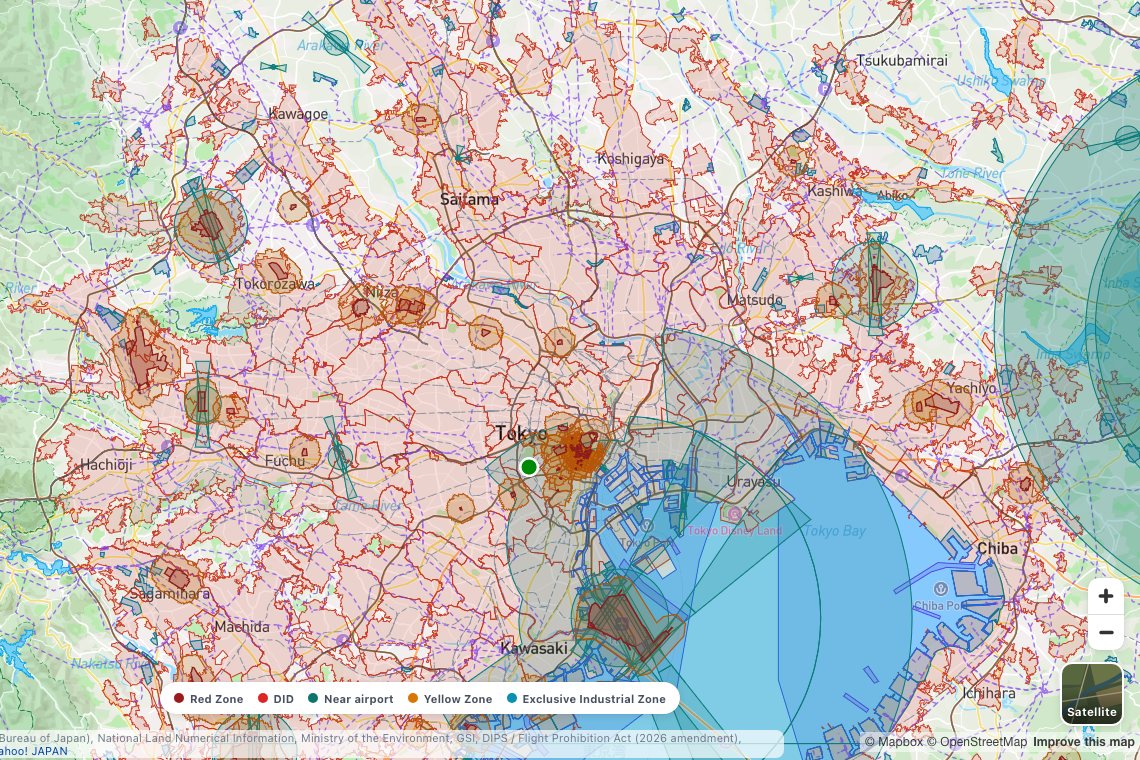
One exception: since July 1, 2026, Exclusive Industrial Zones no longer need this permission even inside a DID (details).
Rules about the place, besides the Civil Aeronautics Act
- The Drone Act: flying is prohibited in principle over important national facilities, foreign diplomatic missions, defense facilities, designated airports, nuclear sites, and similar facilities, and within roughly 1,000 m around them. It applies regardless of the drone's weight
- Local ordinances: parks and similar places may prohibit or restrict flying a drone or bringing one in
- The land manager: even where no government permission is needed, you need the consent of whoever manages the land you take off from and land on
The quickest way is to look at a map
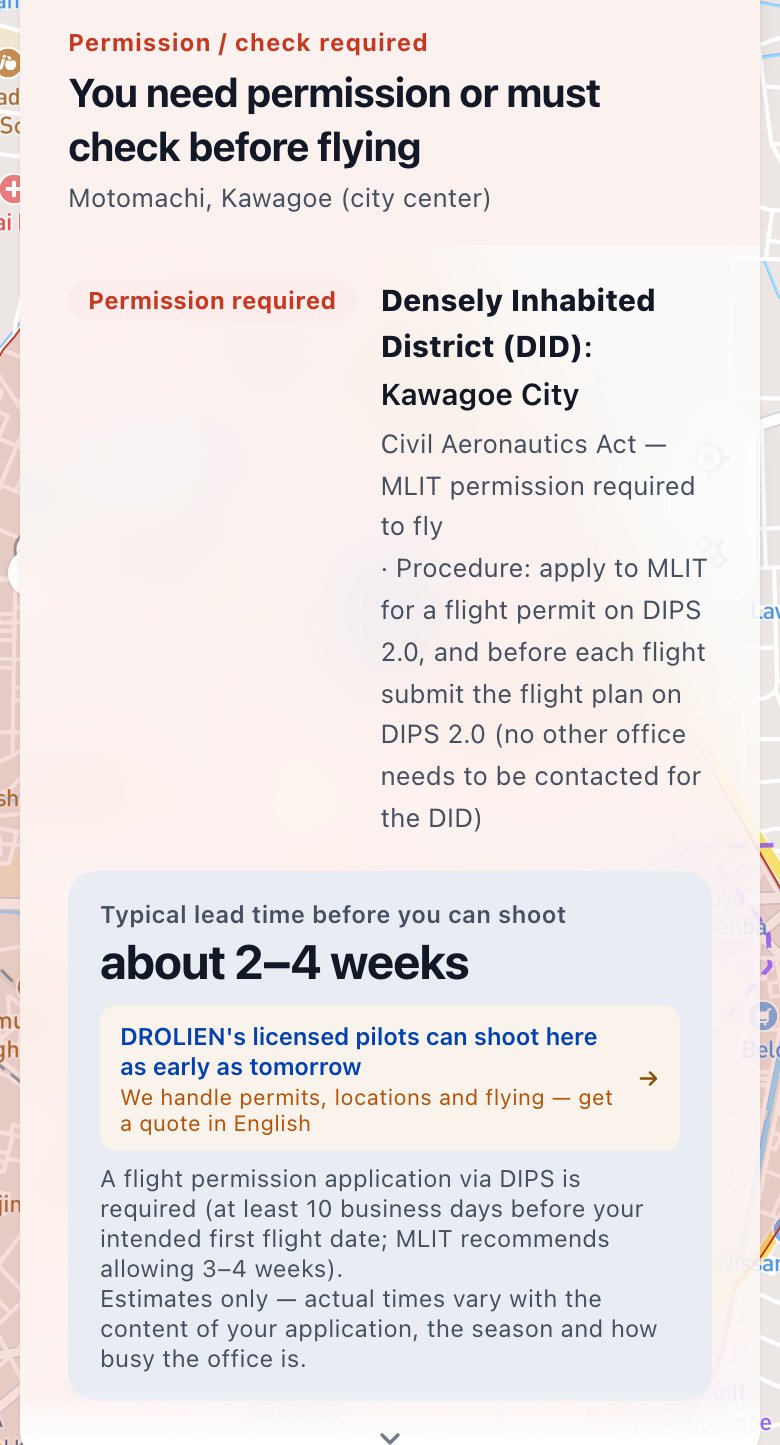
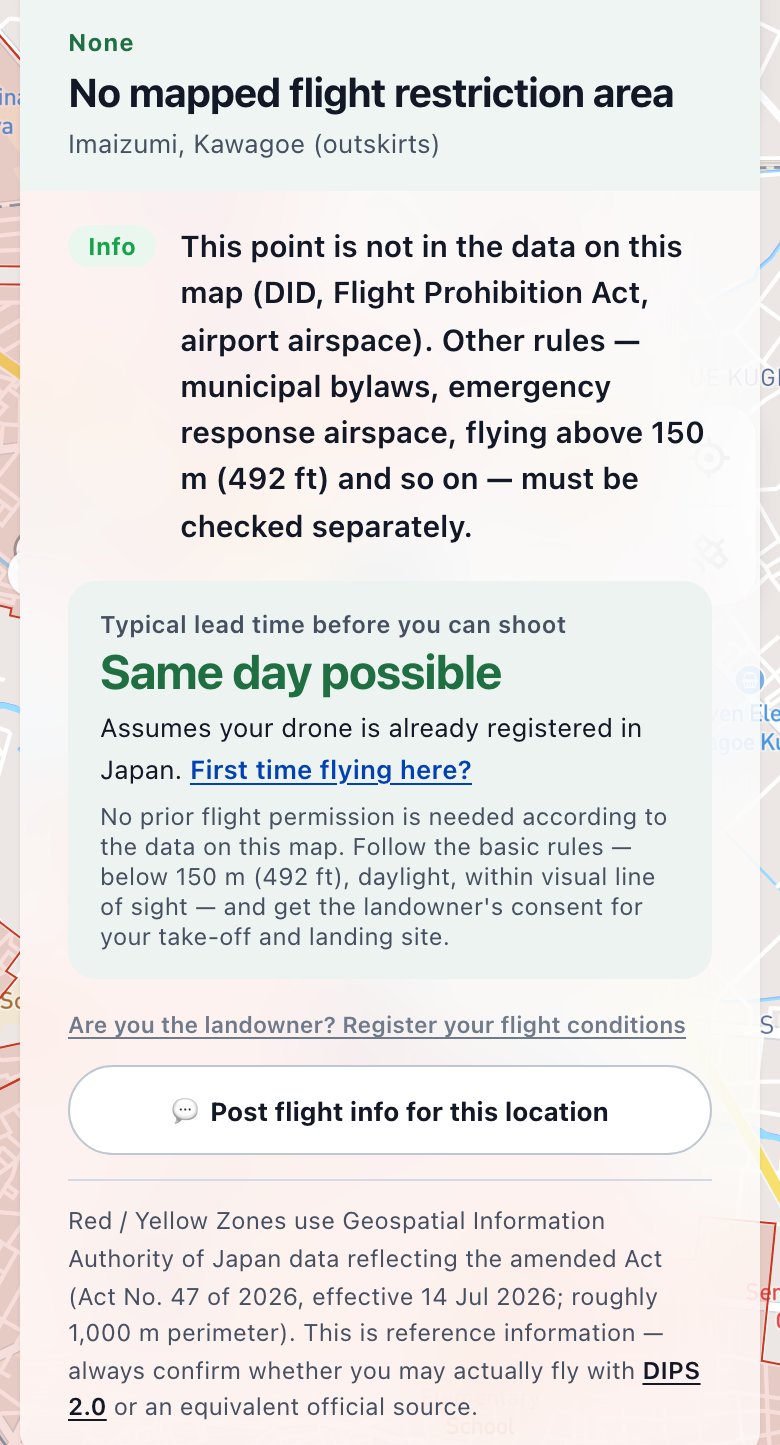
On DroMap, tap a point on the map to see whether it falls inside a DID, the airspace around an airport, or an area covered by the Drone Act. The result changes from place to place, even within the same city.
City center
Outskirts
4How will you fly? Check the way you fly
Even if the place is fine, you need approval from the government to fly in any of the following six ways.
- At nightBetween sunset and sunrise
- Out of sightNot watching the drone directly with your own eyes (flying by the screen alone counts)
- Close to people or propertyWithin 30 m of other people, or of their buildings, vehicles, poles and the like
- Over eventsFestivals and other gatherings of many people
- Carrying hazardous materialsExplosive or flammable items and the like
- Dropping objectsReleasing anything from the drone
When you are starting out, we recommend flying in daylight, keeping the drone in sight with your own eyes, and keeping it at least 30 m from other people and from buildings, vehicles and the like. If your flight avoids all six, you need no approval.
You apply for permission or approval through DIPS 2.0 at least 10 working days before the planned flight. MLIT recommends allowing three to four weeks. The application requires the registration ID, so registration comes first. A flight that needs permission or approval also requires you to report a flight plan in advance and to keep a flight log. Flying without the required permission or approval is punishable by a fine of up to 500,000 yen.
Rules that apply even when you need no permission or approval
- Do not fly under the influence of alcohol or drugs
- Before flying, check the drone, your surroundings, the weather, the remaining battery, and so on
- Fly so as to avoid collisions with aircraft and other drones
- Do not fly in a way that is a nuisance to others, such as diving suddenly
5Do you need a license? No, you can fly without one
Japan's national license (the Unmanned Aircraft Remote Pilot Certificate) is not required for every flight. You can make a flight that needs no permission or approval without a license. You can also apply for permission or approval without one.
However, an applicant without a license is expected to have at least 10 hours of flight experience for each category of aircraft (such as multirotor or airplane), along with knowledge of the regulations and of safe operation.
6If you are bringing a drone from abroad
The rules are the same when you enter Japan temporarily and fly. A drone of 100 g or more must be registered in Japan and equipped with Remote ID before you fly it.
- A drone registered in another country still has to be registered in Japan to be flown here
- DIPS 2.0 can be used from outside Japan, and its screens can be switched to English
- You can verify your identity with your passport, using a smartphone to photograph it and your face. You also need a document that shows your address, such as an international driver's license
- A drone bought overseas must have Remote ID that conforms to Japan's technical standard
- Radio equipment such as the drone and its controller must also comply with Japan's Radio Act. Equipment without the mark showing conformity with Japan's technical standards (the giteki mark) generally cannot be used in Japan. There is an exception for use within 90 days of entering Japan, but it covers only certain certified Wi-Fi and Bluetooth devices
Because it takes days for the registration ID to be issued, we recommend starting the procedure before you travel. MLIT and the National Police Agency publish guidance in English: flight rules, drone registration, and the Drone Act.
7What "Same day possible" means on DroMap
"Same day possible" on DroMap means that the point is not inside any of the restricted areas the map holds (DIDs where permission is required, the airspace around airports, and areas covered by the Drone Act). In other words, within the map's data, no prior permission is needed on account of the location.
The following are not part of that result. Please check them yourself.
- That your drone is registered
- That you are not flying in a way that needs permission or approval, such as 150 m or more above the ground, at night, or beyond visual line of sight
- Local ordinances, emergency response airspace, and the rules of whoever manages the take-off and landing site
Checklist before you fly
To finish, here are the main points in one list. Go through it from the top before you fly.
- I have checked whether the drone (body and battery) weighs 100 g or more
- I have registered the drone and displayed the registration ID on it
- I have equipped the drone with Remote ID
- The place is not inside airspace that needs permission or an area where flying is prohibited (or I have completed the permission or other procedure)
- I am not flying in a way that needs approval, such as at night or out of sight (or I have the approval)
- If the flight needs permission or approval, I have reported the flight plan on DIPS 2.0
- I have the consent of whoever manages the take-off and landing site
- I have checked local ordinances and whether emergency response airspace has been designated
- I have not been drinking, and I have checked the drone, the battery, the weather and the surroundings
Sources
Airspace and flight methods that need permission or approval, and the rules that always apply.
The same rules in Japanese, with the related laws to follow, including the Radio Act.
Mandatory registration, displaying the registration ID, Remote ID, identity verification methods and fees.
Fees, input time and processing time, indoor flight, identity verification with a passport, applicants living abroad, and drones already registered in another country.
What counts as indoors (a space enclosed by a net or wire mesh), and private land inside a DID.
When to apply (at least 10 working days before the planned flight).
The recommendation to allow three to four weeks.
Section 4-2: flight experience required of applicants without a certificate (at least 10 hours for each category of aircraft).
Covered facilities and the flight ban within roughly 1,000 m around them.
The technical conformity mark and the 90-day exception for visitors. Published on the ministry's Radio Use Web Site.
Article 132-2 (registration), Articles 132-85 and 132-86 (airspace and flight methods), Articles 157-7 and 157-9 (penalties).
This article summarizes the main points for beginners, based on the rules as of November 11, 2026. Exceptions and detailed conditions are left out, and the diagrams are simplified for explanation. Before you actually fly, check the latest information from MLIT, the National Police Agency, and DIPS 2.0.
This is an English translation of the Japanese original. If the two versions differ, the Japanese version prevails.
More news
- NoticePlease update the iPhone app (from Nov 24, version 1.3.2 and earlier can no longer check locations)
- UpdateWe renewed the DroMap screen: a larger map, weather at a glance, and the new Measure feature
- ExplainerMLIT amends its Review Guidelines, clarifying how routes over DIDs and similar areas are handled in BVLOS flight without visual observers